What Is the Coffee Flavor Wheel?
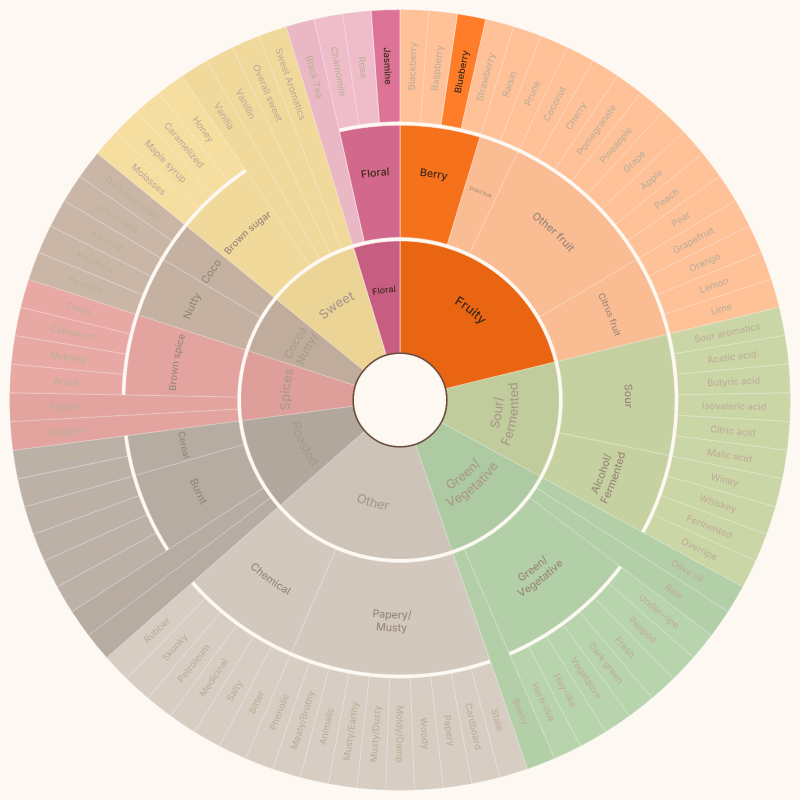
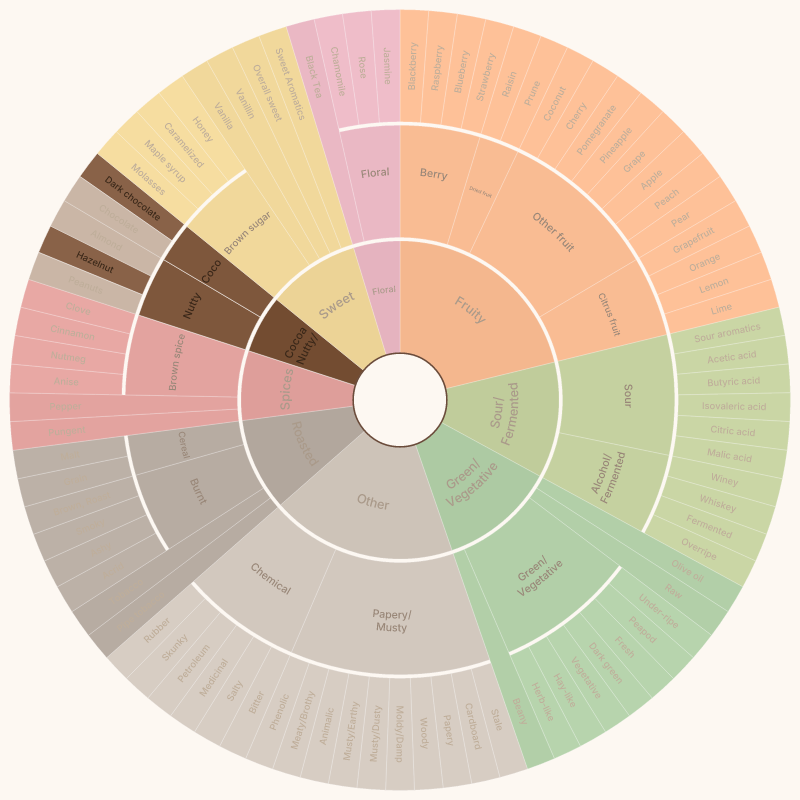
The coffee flavor wheel is a visual reference tool that organizes every flavor, aroma, and texture you might perceive in a cup of coffee. It arranges those perceptions from broad categories in the center out to precise descriptors at the outer edge. Think of it as a shared vocabulary — a map both a Q Grader in Addis Ababa and a barista in Portland can read the same way.
The version most people mean when they say "the flavor wheel" is the SCA Coffee Taster's Flavor Wheel, first published by the Specialty Coffee Association of America in 1995 and comprehensively redesigned in 2016. That redesign was a collaboration between the Specialty Coffee Association and World Coffee Research.
Why it exists
Before shared language existed, flavor description in coffee was impressionistic at best and completely idiosyncratic at worst. "Sweet" meant different things to different tasters. Origin notes on bags were more marketing than calibration.
The flavor wheel solves a specific, practical problem: **how do two people who cupped the same coffee independently arrive at the same language for what they tasted?** It doesn't tell you what a coffee tastes like. It gives you the words to describe what you already perceive — and to compare those perceptions across a table or across a supply chain.
Erna Knutsen, who coined the term "specialty coffee" in 1974, spent decades arguing that provenance and terroir belonged in the coffee conversation the same way they'd always lived in wine. The flavor wheel is, in many ways, the lexical infrastructure that makes that argument stick.
How the hierarchy works
The 2016 SCA wheel is built on a three-tier hierarchy. Start at the center and move outward — from broad to precise.
The nine innermost categories are:
- Fruity
- Sour / Fermented
- Green / Vegetative
- Other
- Roasted
- Spices
- Nutty / Cocoa
- Sweet
- Floral
Each category expands into sub-categories in the middle ring. "Fruity," for instance, splits into Berry, Dried Fruit, Other Fruit, and Citrus Fruit. Then the outer ring delivers the precise descriptors — Blackberry, Raspberry, Strawberry, and Blueberry branch off from Berry. That final ring contains 110 discrete flavor attributes in total.
The color coding is intentional, not decorative. Colors derived from the World Coffee Research Sensory Lexicon indicate flavor families and help tasters visually cluster related perceptions during cupping sessions.
What changed in 2016
The original 1995 wheel was built largely on the intuition of experienced tasters. Useful — but not scientifically grounded. The 2016 redesign drew directly on the WCR Sensory Lexicon, a rigorous lexicon developed using trained sensory panels and calibrated reference standards. Each descriptor on the wheel now has a defined reference — physical or chemical — that a taster can check against.
This is the difference between a folk taxonomy and a scientific one. The 2016 wheel can be replicated. The 1995 one mostly couldn't.
It also looks better. Designer Neal Simons worked with the SCA on a layout that communicates hierarchy at a glance — something the earlier concentric-ring design didn't do as cleanly.
How to read it — in practice
Start at the center. During a cupping, your first job is to identify which of the nine categories fits what you're tasting. Citrusy brightness? That's Fruity. Something earthy and damp? That's probably Green / Vegetative, or possibly Other.
Once you've placed the flavor in a category, move to the middle ring to get more specific. Then, and only then, push to the outer edge for the precise descriptor. Moving directly to the outer ring before you've placed the flavor in context is where errors and disagreements happen.
The process is iterative, not linear. You might start at "Berry" and realize partway through that "Citrus Fruit" is actually closer. That's the point — the wheel is a navigation aid, not a checklist.
Who uses it, and for what
The flavor wheel isn't one thing — it's a tool that does different jobs depending on where you sit in the supply chain.
Roasters use it to describe finished lots in ways buyers understand. "This has a strong berry note" is vague. "Blueberry, specifically, with some dried fruit in the finish" is a cupping note someone can evaluate against the wheel.
Q Graders and competition judges use the wheel to standardize scoring. The SCA cupping form and the flavor wheel are designed to be used together — descriptors on the form map back to wheel positions.
Green buyers use it when communicating feedback to producers. When a buyer says "I'm getting too much Fermented" from a natural process lot, that's actionable feedback a processing manager can work with. "It doesn't taste great" isn't.
Importers, baristas building recipes, and even consumers developing their palates all have uses for it. The wheel scales.
The problem with a poster
Most people encounter the flavor wheel as a PDF, a laminated poster, or a low-res image pinned to a coffee shop wall. That's fine as a reference — but it's passive. You look at it. You don't work with it.
A static poster can't highlight the segments you selected for a specific lot. It can't generate a cupping profile you can attach to a bag label. It can't remember that your Colombian anaerobic natural consistently hits the Berry / Dried Fruit quadrant and your Kenyan AA reliably sits in Citrus Fruit / Floral. The poster is a dictionary. An interactive coffee flavor wheel is a database.
When you're profiling a production roast and you need to export a branded PNG to send to a wholesale buyer, no amount of squinting at a laminated wheel gets you there.
What an interactive version actually does
An interactive coffee flavor wheel — sometimes searched as a "coffee flavor wheel generator" or "coffee flavor wheel maker" — lets you click segments to select them, layer tasting notes into a saved profile, and build a visual representation of how a specific coffee sits within the SCA hierarchy. You can compare profiles, export them, share them with buyers, and update them as a coffee evolves through its shelf life.
For roasters running more than a handful of SKUs, that capability isn't a nice-to-have. It's how you maintain consistency in your descriptions across your team, your season, and your customers.
The best implementations also tie into your existing workflow. Scan the bag with your phone, let AI extract the tasting notes, and have them pre-populated on the wheel before you've finished your first sip. That's not speculation — that's how Profilo already works.
How to Make Your Own Coffee Flavor Wheel (For a Specific Coffee)
The implicit follow-up to "what is the flavor wheel?" is usually "how do I make one for my coffee?" The answer is short — and the workflow is the same whether you're a home enthusiast cataloging a single bag or a roaster building a season's worth of profiles.
Pick the coffee. Cup it (or just sip it carefully) and write down what you taste in broad strokes — fruity, sweet, nutty, floral. Then open the wheel and click the segments that match your read, working from the center outward through the three rings. The result is a personalized flavor wheel for that specific lot — your version of the wheel with only the segments that apply lit up.
The Profilo profile builder handles this end-to-end: click your descriptors, save the profile, then export as PNG or SVG with your brand colors layered on the highlighted segments. That's effectively a free coffee flavor wheel generator built specifically for the 110-attribute SCA hierarchy — no design software required.
Ready to move beyond the poster? Try the interactive SCA flavor wheel — the closest thing to a free coffee flavor wheel generator built specifically for the 110-attribute SCA hierarchy. Click the segments, build a profile, and see what the full 110-attribute hierarchy looks like when it's alive on screen.
The full SCA hierarchy — 110 flavor attributes, interactive and free. Explore, click, and build a tasting profile in minutes.
Explore the wheel →